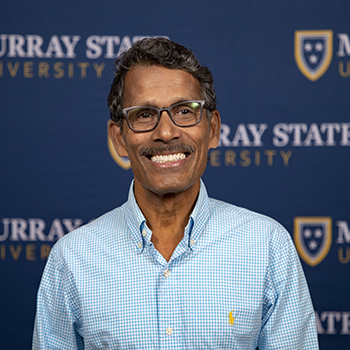
Dr. Bommanna Loganathan

Dylan Benningfield
Dylan Benningfield, sophomore Chemistry major at Murray State University and recent recipient of an URSA Research Scholar Fellowship, is working with Dr. Bommanna Loganathan, researcher for the Watershed Studies Institute and Associate Professor in the Department of Chemistry. Benningfield, a member of the Murray State Honors Program, received the fellowship for his proposal “Trace Level Analysis and Contamination Profiles of Triclosan in Western Kentucky Waters.” Loganathan and Benningfield began collaborating on Triclosan research while Benningfield was still in high school. Their previous research on this subject was recently presented at the Dioxin 2009 symposium in Beijing. Triclosan, a common antibacterial ingredient found in household products like soap, toothpaste, and cosmetics, has resulted in environmental contamination.

Dr. Todd Levine, WSI postdoctoral associate, has recently had his research reported in the popular press. As a graduate student, he and his collaborators discovered an unusual situation: an immature dragonfly crawling through the gills of a freshwater mussel. As they watched they realized that the dragonfly had been eating the gills. Thinking that this was very unusual, they flushed the guts of the dragonfly to determine what else it had been eating. They also examined the mussel population for gill damage. These data supported the conclusion that the dragonfly larvae were, in fact, attacking the mussels. Because no dragonfly had ever been reported to attack mussels, their paper describing the occurrence was published by the American Midland Naturalist this past June (2009). More recently, Natural History Magazine, a popular press magazine affiliated with the American Museum of Natural History, published a short summary of the research in their September 2009 issue (http://www.naturalhistorymag.com/samplings/201525/a-mother-s-burden).

WSI Supports Graduate Research

The Watershed Studies Institute is pleased to announce the awardees for its first Graduate Research Awards Competition. Seven excellent proposals were selected for funding, each of which is aimed at furthering our understanding of aquatic systems. The awardees, their graduate program, mentors, title of their proposal, and the awards they received can be found here. Please congratulate these students and their mentors for their accomplishment.
 
News Archive

The Watershed Studies Institute (WSI) was originally established as the Center for Reservoir Research (CRR) in 1987 by the Kentucky Council on Higher Education as a Center of Excellence for Teaching and Research. In 2009, CRR was changed to WSI in order to better reflect the diversity of research that had been completed over the preceding 20 years, and to continue to broaden the research focus of the Institute. The mission of the Institute is to provide the infrastructure, support, and intellect for education and research of watershed ecosystems. WSI sponsors three research centers, a long-term monitoring program on Kentucky Lake, and support for undergraduate and graduate students, postdoctoral research associates, and visiting scientists. The three research centers that comprise the support base for Institute research and educational activities are the Chemical Services Laboratory (CAL), the Hancock Biological Station (HBS), and the Mid-America Remote Sensing Center (MARC). Each facility functions in response to individual or team needs and serves as an educational center for graduate and undergraduate studies in watershed studies.

For further information, contact:

Dr. Howard H. Whiteman
Director, Watershed Studies Institute
Department of Biological Sciences
Murray State University
Murray, KY 42071
Email: howard.whiteman@murraystate.edu
Phone: (270) 809-6753
FAX: (270) 809-0120

The Murray State University Board of Regents approved the establishment of the Mid-America Remote Sensing Center (MARC) in 1979. MARC is administered through the Office of the Dean of the College of Science. MARC provides facilities for formal education related to programs at Murray State which utilize remote sensing and Geographic Information Systems (GIS) technologies. Technological assistance is offered to the public and private sectors in addition to research conducted by faculty, staff, and students.

The Hancock Biological Station (HBS) on Kentucky Lake is a year-round facility providing scientists with a base of operation for a wide variety of field research and presenting students with opportunities for field-oriented classes, individualized instruction, independent research, and close interactions with researchers and faculty. HBS is the Field Facility for the Center For Reservoir Research and for the Ecological Consortium of Mid-America (ecoma).


The Chemical Analysis Laboratory is equipped with state-of-the-art instrumentation enabling high-quality instruction in environmental analytical chemistry at both the baccalaureate and graduate levels. The CAL also provides a number of analytical and environmental services to individuals, corporations, and other institutions in west Kentucky, the greater Ohio Valley region and beyond in fulfillment of the WSI regional economic service role.

Last Updated July 9, 2009
Questions or problems? Support