
College of Education and Human Services faculty member pioneers interactive AI-powered graduate course
By Jillian Smith | Jun 3, 2026
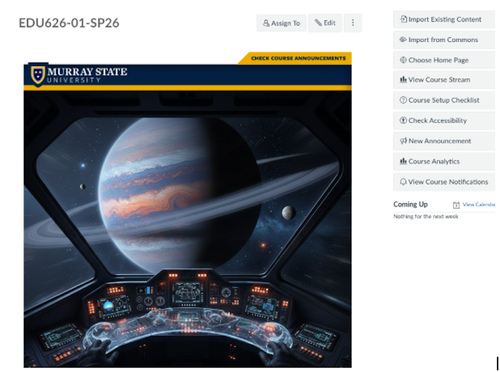
MURRAY, Ky. — When Dr. Jessica Pryor, assistant professor in early childhood and elementary education, began redesigning her EDU 626 course for the spring semester, she decided to take an unconventional approach: allowing artificial intelligence to help teach the class.
EDU 626, an asynchronous educational technology course offered through the Instructional Technology Endorsement program in the College of Education and Human Services, introduces graduate students to ways technology can be effectively integrated into educational settings.
Instead of relying on traditional lecture videos and written notes uploaded to Canvas, Pryor designed the course around Google Gemini Gems — customizable AI chatbots that delivered course material in a personalized, interactive format.
While the course embraced emerging technology, Pryor said the foundation remained rooted in ethics and responsible use.
“We always begin with ethics,” Pryor said. “Students need to understand both the potential benefits and the risks and responsibilities of using these tools.”
Early course discussions focused on standards set forth in the Family Educational Rights and Privacy Act of 1974, including responsible AI practices and the risks of overreliance on technology. Pryor emphasized that AI was never intended to replace educators, but instead serve as a tool to support more responsive and personalized learning experiences.
One of the biggest challenges in designing the course was ensuring the asynchronous format still felt engaging and human-centered. To address this, Pryor collaborated with Casey Stubblefield, a recent Murray State computer science graduate and current Master of Business Administration student with a concentration in business analytics, who helped improve the student experience through course navigation, storytelling elements and visual design.
“Mr. Stubblefield is great to collaborate with,” Pryor said. “I know my content, and I have experience building with the faculty-facing side of Canvas and Google, but he is great at evaluating and improving the student experience, and that’s what matters.”
Stubblefield said the project focused on reimagining the course structure to better capture students’ attention, using interactive elements and storytelling techniques to create a more engaging learning experience for students with diverse learning styles.
“We took her lesson plans and transformed them into a game-style narrative that students could actively move through,” Stubblefield said. “Instead of feeling like they were just reading information, the course became an interactive adventure that made learning more engaging and personal.”
The result was a course experience intentionally designed to push students outside of their comfort zones while encouraging creativity and experimentation.
“This is not a traditional asynchronous course,” Pryor said. “I noticed that when students are already outside of their comfort zones, they are willing to take more chances and try new things.”
Although Pryor initially anticipated setbacks, student responses quickly demonstrated the project’s success. Many students began building their own AI-powered classroom tools, including tutoring chatbots, substitute teaching assistants, interactive book characters and simulated patients for health science case studies. Building a chatbot was never a course requirement, but students embraced the opportunity to explore the technology in practical ways.
“My first moment of ‘wow, we did something really cool,’ happened when a student reached out and said, ‘I’m having trouble getting my bot to stop overexplaining the topic to my kids,’” Pryor said. “That’s when it occurred to me that this was working — they were building their own bots for use in their classrooms.”
Pryor said one of her primary goals was creating a course that prioritized practical application over abstract theory.
“College courses sometimes take criticism for being too theoretical or abstract,” Pryor said. “I wanted to build something that would actually work and make students’ jobs easier.”
Despite the course’s heavy integration of AI tools, Pryor maintained a clear boundary regarding student assessment and feedback. AI chatbots delivered content and personalized learning support, but grading and feedback remained entirely human-driven.
“Feedback is where the real learning happens,” Pryor said. “As a professor, I need to understand what my students are understanding. I don’t want a bot to do that.”
Pryor said the rapid pace of change in generative AI and educational technology continues to present challenges, particularly in keeping course materials current. Even so, she believes educators benefit from exploring emerging technologies firsthand so they can thoughtfully determine how those tools may — or may not — fit into their classrooms.
For Pryor, the project ultimately became less about artificial intelligence itself and more about innovation, curiosity and reimagining what teaching and learning can look like in higher education.
“Innovation does not always start with expertise,” Pryor said. “It begins with curiosity.”