
Murray State University partners with McCracken County High School and Department of Energy for hands-on environmental science research
By Alex Sherwood | Oct 30, 2026
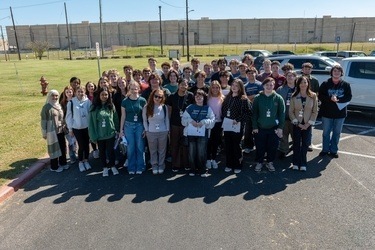
MURRAY, Ky. — Expanding a powerful regional workforce development pipeline, 50 students from McCracken County High School completed a specialized technical tour of the U.S. Department of Energy (DOE) Paducah Site on Sept. 29. The site visit serves as a cornerstone for student research funded by a five-year, $1.5 million DOE grant awarded to Murray State University.
The participating cohort included 36 students from Amanda Atnip’s Advanced Placement (AP) Environmental Science class and 14 students from Brian Gill’s Capstone Engineering class. Under the direction of Murray State faculty and DOE subject matter experts, these high school students are applying classroom science, technology, engineering and mathematics (STEM) theory to real-world remediation, environmental monitoring and engineering challenges at the former Paducah Gaseous Diffusion Plant.
Connecting high school classrooms with federal science
Through this partnership, Murray State University and McCracken County High School are bridging the gap between secondary STEM education and real-world scientific communication. By engaging with federal environmental datasets from the DOE Paducah Site, high school students gain hands-on research experience that prepares them for higher education and future careers in engineering, environmental science and occupational safety.
The primary objective of the DOE-funded partnership is the student-led development of the Student Annual Site Environmental Report (ASER) Summary. The 400+ page technical ASER document contains vital empirical data regarding air quality monitoring, groundwater remediation, radiological safety and site restoration.
Through this initiative, students analyze federal dataset metrics—such as verifying the site’s radiation dose remains well below the annual federal limit—and translate those findings into clear, accessible visual poster exhibitions and reports for the community.
During the Sept. 29 site visit hosted by DOE General Engineer Mitchell Guthrie and technical site personnel, students observed environmental monitoring stations, groundwater pump-and-treat systems and facility decontamination operations firsthand.
A multi-disciplinary STEM pipeline
The site tour directly integrates into the high school curriculum, backed by dedicated Murray State faculty support:
Engineering Capstone (Brian Gill): Instructed in Student ASER 101: Core Fundamentals by Dr. Tyler Stoffel from the Murray State School of Engineering, students examine treatment system modifications, system flow dynamics and material evaluations.
AP Environmental Science (Amanda Atnip): Guided by Dr. Melburn Dayton from Murray State’s Department of Occupational Safety & Health, students focus on environmental exposure pathways, air quality monitoring and groundwater plume dynamics.
“This initiative is designed to move regional students beyond the textbook and directly into active scientific communication and technical research,” said Associate Provost and Principal Investigator at Murray State University Dr. Renee Fister. “Through our ongoing collaboration with DOE and site contractors, we are building upon a direct academic and career pipeline for the next generation of engineers, environmental scientists and safety professionals right here in western Kentucky.”
Next steps and community outreach
Following their field research, the student teams will develop research poster topics covering site history, environmental restoration and remediation, groundwater plumes, deactivation and remediation, radiological monitoring and careers at the Paducah Site.
Their final research posters will be showcased during a public Student Poster Exhibition in the spring at the Murray State University Paducah Regional Campus, with visual summaries published on the grant’s official public portal at murraystate.edu/doegrant.