
Murray State University student participates in NASA RockOn event
By Dani Ray | Jul 8, 2026
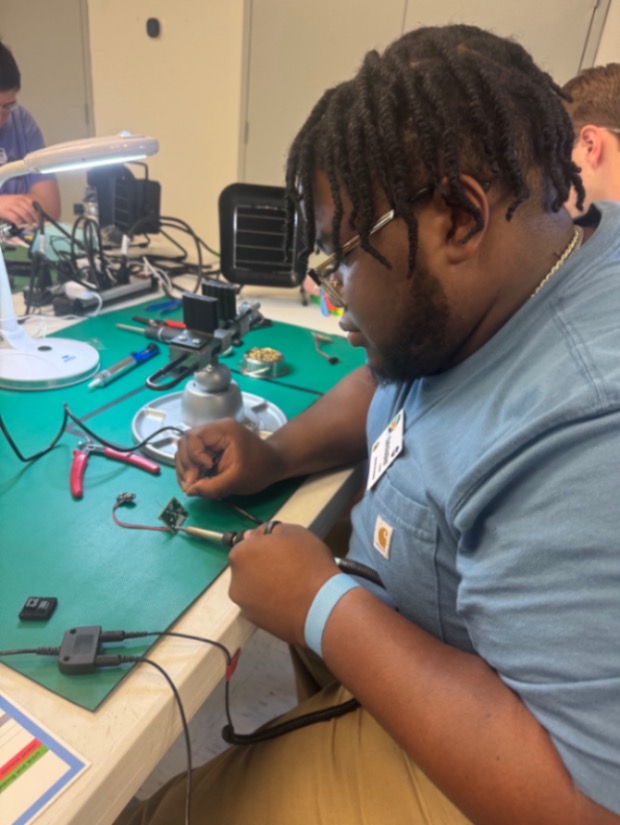
MURRAY, Ky. — Christopher Puckett, a junior aerospace engineering major from Metropolis, Illinois, recently participated in NASA’s RockOn event — a workshop where students and faculty spent seven days building sounding rockets to launch into space — at the Wallops Flight Facility in Virginia.
NASA Kentucky funded the workshop for the University of Kentucky’s (UK) Lexington team, who reached out to Dr. Tyler Stoffel, assistant professor of engineering physics at Murray State University and principal research engineer for the University of Kentucky’s Computational Thermophysics and Fluids Laboratory, and invited a Murray State student to join Natalia Martinez and Luc Powell from the UK team at the NASA RockOn event.
“When the folks from UK asked if we’d like to send a student, I assumed they wanted a senior student who was nearly fully trained as an engineer with significant experience already,” said Stoffel. “Instead, they said to send whoever is the most interested and dedicated to a future in aerospace engineering. That made Christopher the obvious choice. Ever since I had him as an incoming freshman student in EGR 101, he has consistently demonstrated a very outspoken interest in the field. He’d been watching documentaries on space missions, reading articles and studying up for years before coming to Murray State. He spent many hours in my office asking questions about my research and work with NASA. Every time I’d send him away with a new topic to study, he’d always come back having discovered something I didn’t even know about.”
Puckett said when Stoffel asked him to take part in the event, he had to agree.
“The moment felt like my biggest dream was coming true right then and there,” said Puckett. “I’ve always wanted to be a part of something NASA related and being asked to be the student that teams up with UK to go to the NASA RockOn event made me feel very ecstatic. Every day leading up to the event, I felt very blessed and grateful for the opportunity to even do anything like this.”
Puckett has always been interested in space and building things.
“I’ve spent so many summer breaks watching space videos and documentaries learning more and more,” said Puckett. “It’s always been interesting to me, but when I was in the seventh grade, I was researching different types of engineering so I could get ready for college, then I saw aerospace engineering, and it immediately called out to me since it combined two of my biggest interests.”
Puckett said the NASA RockOn event was an amazing and unbelievable experience. His group was even chosen to be one of three groups out of 24 to have their experiment put on the lid of the capsule.
“We built a Geiger counter that was able to measure radiation of objects nearby or the surrounding area,” said Puckett. “We did a lot of computer coding with Arduino software to make an experiment that was connected to the Geiger counter such as a gyroscope tracker which would read how the orientation of the device changed from its original axis, a magnetometer which would track the strength of magnetic waves, humidity sensors and accelerometers.”
Puckett said the most rewarding part of the experience was seeing the rocket launch, then collecting the experiment and getting the data.
“Watching that rocket launch in person was one of the most magical things I have ever experienced from the sound of everyone counting down from 10, until hearing the rocket launch and disappearing into the sky,” Puckett said. “Then to hear that our experiment worked flawlessly and to see all the data we got from space was a huge relief and a testament to how you can take three completely different people, but together they can create something great. Our team was not made of people who had experience together or knew each other from events. We all came into this not knowing one another at all; we communicated with each other through emails and talked a bit, but we still had never met until we were heading to the event. It was different meeting new people that would eventually be working together on an experiment that would be sent to space, but by the end of the event, it felt like we had all known each other for a very long time.”
After the NASA RockOn event, Puckett said he feels like he learned so much valuable information.
“You learn a lot in the classrooms but there is a lot of information that you can learn just from doing an experiment or working on different systems,” said Puckett. “Before the workshop, for some reason I would not think twice about using some type of conformal coating for your electronics, but now I know that would be a pretty terrible idea. But there were so many new things that I have learned from this event that I know will be more than valuable to real world applications and even understanding aspects of classroom material even more.”
Puckett said the event was even better than he could have hoped.
“Without looking at the activities done in the workshop, the team I had made it so much more fun,” said Puckett. “We all had a passion for engineering and space, it brought us all together and we had so much fun together doing that and watching that rocket launch with your team adds to the moment so much more than if I was alone. Talking to one another about how it made us feel, that feeling is something I’ll never forget. I made a lot of extremely valuable connections throughout the event. I met former NASA engineers, I met someone who was a project manager for the Transiting Exoplanet Survey Satellite project, I got business cards and even got to ask many questions on different processes and methods used by NASA. I even got to meet people who worked at NASA headquarters in Washington, D.C. I met so many amazing and incredible people who have done some truly incredible work and to get to meet and connect with them was an honor.”
As for his future, Puckett would like to land a NASA internship, which will be greatly helped by his participation in the RockOn event.
“I hope to work at NASA after finishing my degree at Murray State University, along with wanting to get a master’s in aerospace and mechanical engineering,” Puckett said. “But I also want to help get something started at Murray State that gives other students the chance to get experience with engineering applications like soldering and possibly even getting a team that could go to NASA RockOn to represent Murray State University.”
Stoffel said the RockOn workshop has already given Puckett some great connections in the field of aerospace engineering.
“It will strengthen his application if he chooses to apply for a NASA undergraduate internship next summer,” said Stoffel. “He also has picked up some ideas for aerospace related projects we could be doing here in the School of Engineering. Some students in the program have been taking steps towards starting a rocket club. I think his experience at the workshop could help that team, as well.”
Puckett added, “I do want to give a big thank you to the University of Kentucky for letting me be a part of their team, a big thank you to Dr. Stoffel for everything he’s done and a big thank you to NASA Kentucky for helping me fund the entire trip like travel expenses and meals.”