
Students help provide life-changing communication device for local child
By Jillian Smith | Apr 21, 2026
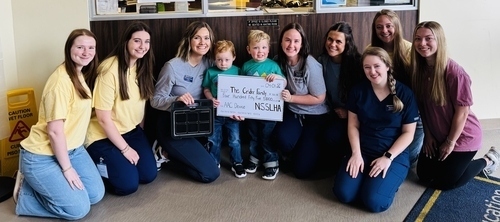
MURRAY, Ky. — A collaborative effort between faculty and students in the Center for Communication Disorders (CDI) at Murray State University has helped provide a high-tech augmentative and alternative communication (AAC) device to a local child, Hardie Crider, opening new pathways for communication, independence and connection.
According to the American Speech-Language-Hearing Association (ASHA), an AAC means all of the ways that someone communicates besides talking. People of all ages can use AAC if they have trouble with speech or language skills.
After months of therapy, advocacy and fundraising, undergraduate members of the National Student Speech Language Hearing Association (NSSLHA) donated $500 to cover the out-of-pocket cost of the device—an expense the Crider family was unable to afford. The device has now been shipped and is expected to arrive soon.
“Our organization was inspired to cover the cost of the AAC device after recognizing just how essential communication is to a child’s ability to connect, learn and fully engage with the world around them,” Melati Free, president of NSSLHA said. “As students studying communication disorders, we understand that communication is more than words; it is a fundamental human right.”
Hardie has been receiving weekly therapy services at Murray State’s Speech and Hearing Clinic, where graduate student clinicians have played a key role in his progress. Through structured sessions, students introduced both low-tech and high-tech AAC tools, gradually building the child’s ability to communicate effectively.
Graduate clinicians worked closely with Hardie’s clinical supervisor to document progress and submit a report for insurance approval for a personal device. Throughout the process, they also provided consistent updates and support to the child’s family.
Mary Grace Starks, CDI instructor, said graduate students at the Murray State University Speech and Hearing Clinic deliver weekly therapy sessions focused on developing targeted language skills, helping Hardie become a more independent and effective communicator.
“Graduate students have strategically worked with him to teach him how to use switches (a low-tech form of AAC) and slowly began introducing an iPad with a specific communication system (a high-tech form of AAC),” Starks said. “As Hardie became increasingly more successful in his communication attempts with the iPad AAC system during his therapy sessions with his graduate student clinicians, they worked, in collaboration, with their clinical supervisor to write and submit a report for insurance approval to receive a personal AAC device. The students provided updates regarding Hardie's progress with his AAC system with his family members who were present for his sessions.”
Students involved in the effort say the experience reinforced the importance of service and real-world application of their studies.
“It is important for students to support community members in this way because it allows us to transform what we learn in the classroom into meaningful action,” Free said. “Experiences like this cultivate empathy, compassion and a deeper understanding of the real challenges individuals and families face.”
Free said this initiative reflects NSSLHA’s mission of advocacy, service and professional development, while also highlighting the impact of hands-on clinical training within the department.
“By donating money for an AAC device, our organization demonstrated a commitment to empowering individuals through accessible communication,” Free said. “It embodies our mission of preparing future professionals who strive to make communication accessible for all.”
This effort underscores the power of collaboration between faculty, graduate clinicians and undergraduate students—demonstrating how academic programs can directly impact lives in the community.
For more information about the Center for Communication Disorders at Murray State University, visit murraystate.edu/cdi.